

Greg's Right FIT #568–This week: Timing, Sales literacy, Procrustes
Quick notes to help you find new business in less time with less effort. . . sometime next week.
In this issue:
- Thoughts about The Best Time
- Being Human
- Random Stuff
- Back In The Day
Thoughts about The Best Time
- We want to know when the best time to call a prospect. A client sent a report detailing the finding from tens of thousands of calls to their niche. They want to know what I think and I quote Mr. Carl: "it's better to be there than to be good." Making the call matters more than when you call. We can figure the rest out.
- It's not just helpful to think that someone, somewhere in your prospect list is about to buy a solution just like yours, it's true. Selling is less about talking buyers into something than uncovering what buyers are already looking for. If we believe this, the best time to reach out is close to right now.
- Not knowing what's going to happen keeps people from taking action like, say, calling a stranger. Today there's a good chance non one answers. But if that's not comforting because what if they do answer? What do we say? Another Mr. Carl saying, "leap and the net shall appear" is helpful here. Trust that you'll figure it out.
- Since most calls go to voicemail, get your script ready. Practice it on your phone and read the AI summary output. Does it sell well in preview? You read the preview before deleting the voicemail, right? If you do it, your prospect does it.
Being Human – Sales Literacy
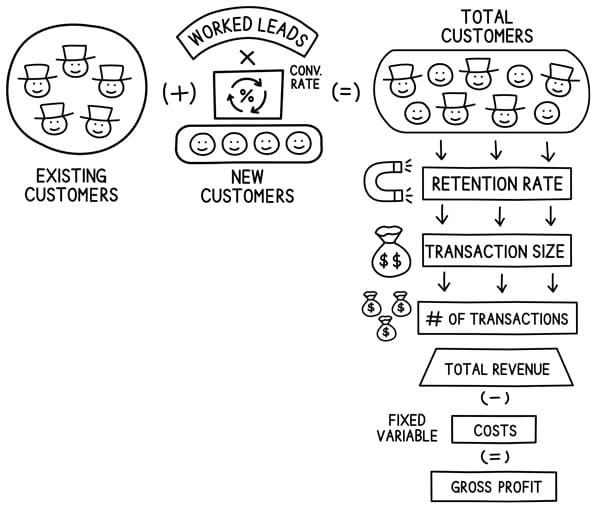
Meeting today's smart, young, and restless sales people involves trying to get on the same page in order to communicate effectively. It's tough because sellers and marketers use a lot of the same words but use different definitions. I've used the above map graphic as a shortcut to orient the conversation. It helps.
The way it works is to place the topic of conversation on the map. This week we were talking about Account Based Marketing (ABM) tactics with a marketing team not happy with the feedback from sales. This is in the "Worked Leads" section. This oversimplifies the conversation, but it helps orient the conversation. The group wants to improve the tooling, but in their business, the Existing Customer circle is 50x the size of the New Customer portion.
The map helps us orient the conversation. In this case, it's useful to know existing tools are in place are built to help with Existing Customers. Makes sense. It's most of the company's annual sales. To improve feedback we might not be able to change the tool, but we might be able to train the salespeople how to give better feedback.
Make a map. It takes a minute to orient everyone, but improves communication.
Random Stuff
Last weekend my lovely bride was out of town. I had a big list of to-do's for the weekend because the weather was nice, but my body had other plans. I spent most of the weekend nursing myself back to health, passing the time by editing my murder mystery and reading commercial fiction.
I started with "Neuromancer" by William Gibson. I don't read much science fiction but enjoy it. This came out in 1984 and had some prescient AI bits. Like most sci-fi, the world building is amazing. Invented words (like cyberspace) and weird locations are easy to get lost in. (looking it up right now I see a reddit post titled "I am 80% of the way through Neuromancer and I don't understand a thing he's talking about" – totally get it.) The second book was from Harlan Coben. The first book in his Myron Bolitar thriller series, "Deal Breaker." A fast-paced airplane book. Kind of Jack Reacher-esque if you like those.
Both books sold millions of copies. Reading them and then looking at my manuscript while being laid up was probably not the best way to get through my convalescence. Their characters are way bigger than life, the worlds they inhabit sharp and focused. My effort pales in comparison. It's too late to re-write this thing from scratch, but I can do one part. I'm still at 125K words. "Deal Breaker" clocks in around 87K and "Neuromancer" is a fast 67K! Holy editing, batman!
Time to start chopping.
Back in the Day
What I was thinking about last year, five years ago, and ten years ago.
- Last Year: Right FIT #516 – Fighting value sticks out. What do you do when you know deep down that you are providing incredible value but your prospect doesn't understand? Educate, sure, but remember that value comes from the problem being solved or result it gives. If the prospect doesn't see it, it might not be there.
- Five Years Ago: Right FIT #307 – The discomfort we feel when learning something new is real. It's no wonder we look for shortcuts. Right now I have two clients that are in love with Claude and ask questions or send me instructions from questions they ask it. It's hard to explain why the questions are off or instructions won't work, so, right or wrong, my response is to let them implement on their own. Maybe it will work? I've been known to be wrong.
- Ten Years Ago: Right FIT #45 – Man, I used to write a lot for industry journals. Except for pitching for clients I've stopped pursuing it. Part of it is me, but part of it is the change in journalism. Sending an industry article to a prospect doesn't seem to hit as hard as a podcast video snippet these days.


