


Quick notes to help you find new business in less time with less effort. . . sometime next week.
In this issue:
- Thoughts on Customer Decision Making
- Being Human
- Random Stuff
- Back In The Day
Thoughts on Customer Decision Making
- A momentum mindset demands we take action, but tells us to be patient with results. Developing new clients relies on multiple events and decisions taking place. Momentum keeps those events and decisions in motion, but matches it with patience. It takes time for results to come in.
- When we help clients make decisions give equal weight to the unknown in addition to the known. In other words, to be "sure," be willing to admit where you are "unsure." It's a way of making a "no" decision as valid as a "yes" decision, and moves sales cycles forward faster.
- Sales team research shows 80% of marketing budgets are spent on producing leads, the rest on follow-up. Buyer research tells us buyers plan on making a purchasing decision, "eventually." My advice? Move some marketing spending to follow up.
- Giving your prospect options moves decision-making forward. Options magically change a buyer or buying team's discussion from "should we do this? Yes/No?" to "what's the best way for us to do this?"
Being Human – Attribution
"Statistical formulas don’t know whether they are being used properly, and they don’t warn you when your results are incorrect." – Deborah J. Rumsey

Attribution is tricky business. I'm helping a marketing startup get going and the early prospects want proof that his lead generation tool works. "Show me the case studies," they say, "give me the attribution." I tell them stories about lessons learned from twenty years of analyzing sales lead generation programs. I have played detective and been tasked with figuring out where new business is coming from. I've listened to generations of sales and marketing people brag about their ability to track leads, thereby streamlining marketing spend. I remind them it's never a clean path. At best it's a rhyme. Attribution is a law of big numbers tool versus a specific instance tool. We say, "In general we can expect [X] outcome most of the time," which sounds like a promise when it comes from a salesperson. It takes on the characteristics of a grand unifying theory. Do this, get that.
Grand unifying theories are fun, but when it comes to finding more new business they aren't helpful. I sat through a presentation where the sales training company dug into the marketing budget and came to the conclusion that 60% of budget being spent on direct mail is best re-directed to webinars. Their method included a lot of great looking calculations like:
- Average Cost Effectiveness for a Lead within a Leadsource = Revenue Contribution Leadsource / Total Cost Leadsource
- Average Lead Turnover for a Lead within a Leadsource
= Business Days / Leadsource Closure Speed - Average Overall Effectiveness of a Lead within a Leadsource
= Cost Effectiveness Leadsource * Ave Lead Turnover
Useful calculations, but not if they're built on shaky data. I tell them a story of the car dealership where we did an in depth analysis of their lead sourcing from data in the CRM, but it didn't match what their customers were telling us about their decision process. The ownership, the brand managers, and the sales managers were all in the room when we described the mismatched story the data was telling us. Five minutes in, one of the sales managers pipes up and tells me he thinks he knows the reason why "referral" is their #1 lead source despite customers not saying they are getting referred in. It's because "referral" is first entry on the dropdown list in the customer processing software. He thinks most salespeople pick it without ever asking the customer the attribution question. They make a quick click, then move on to the important parts of the paperwork.
The owner is visibly upset at hearing this. How do you think you can help us, he asks me, but he knows the answer. Before changing anything with ad budgets and campaigns, clean up the tracking.
Attribution is tricky. It helps to manage the process at a high level and help us come up with a lot of experiments until we find a lever that moves the business. It's not fast. It's easy to jump to the wrong conclusion and make a hasty bet on a new direction. There's a reason the tenure on most VP Sales and VP Marketing positions is less than 24 months.
Sometimes project #1 is figuring out where you are today. When you have that you can test a new tool like my friend is selling and come up with your own KPIs and case studies. Results that are dialed in to your business, today.
Random Stuff
“There are no birds, squirrels, insects or any other living creature indigenous to planet earth at the Masters. Nowhere on the property."
– The Washington Post’s Thomas Boswell
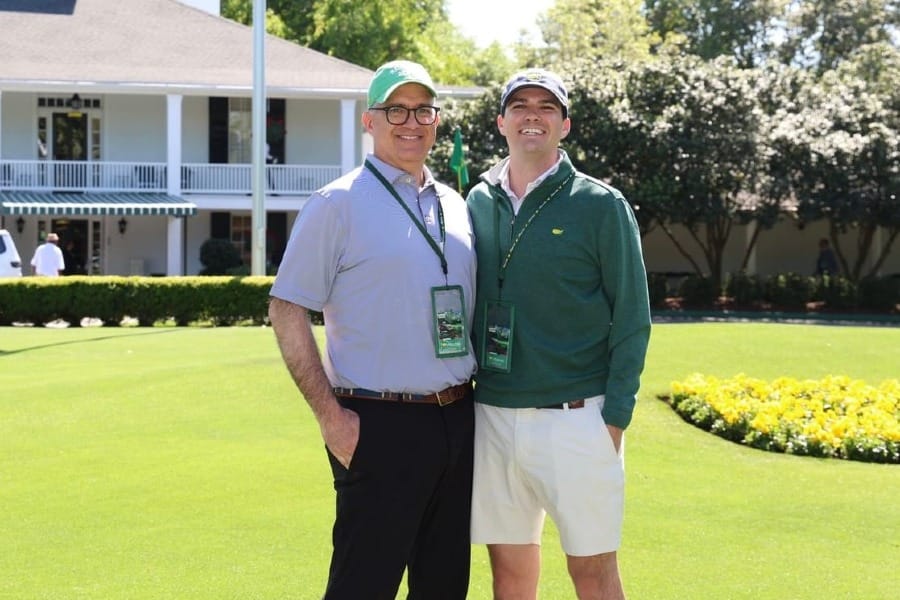
The spring is coming on in full force. The neighbors and I are out clawing around at the ground as the early blooms on trees and bushes push their way into the season. The birds are 'getting up and at 'em' earlier because the days are getting longer. Color is popping all around. On a recent walk to meet another couple for dinner, my lovely bride and I are admiring the foliage and right in front of us a big hawk swoops down from one tree to another. A few feet from our faces. It was very dramatic.
At the Masters golf tournament, everything was already in bloom. They're a good month or more ahead of us weather wise. The famed azaleas weren't out this year, having bloomed two weeks earlier, but everything else was. Without televisions or phones, the grounds were pretty quiet. Walking from hole to hole we could hear birds singing (I remember a bluejay's distinct song multiple times) making the scene like something out of a movie. It was like Disney World for golfers. Nothing seemed real, but it was all perfect.
I went to the tournament with my eldest boy, now a man. He asked if my friends were peppering me with questions about seeing birds at the Masters. It turns out that there's a conspiracy theory about the lack of wildlife on view at Augusta National. For years, patrons have said they never see any. No birds, no foxes, no squirrels, or field critters. I didn't notice any. Just the sound of birds.
Well, the conspiracists say, what you're hearing are sounds being piped in. The masters at the Masters want it to be so perfect they add nature sounds. There are speakers all over the course. And that may be. My son and I commented on a number of people lurking in the bushes, and expertly camouflaged cameras spotted around the course. The place really is like Disney. 40,000 people, no trash blowing around. People talking. You can put your seat down, walk away, and if someone is using it when you return a simple, "excuse me," gets them to move.
I get it. Sounds can be manufactured. Tiny microphones might be listening to me prattle on about how little I know about golf. Hidden speakers could be enhancing my auditory experience.
Or, maybe I was just so focused on trying to find a little white ball and seeing who hit it that I missed a few things. It happens.
Back in the Day
What I was thinking about last year, five years ago, and ten years ago.
- Last Year: Right FIT #485 – Fresh off a trip to Los Angeles to visit the daughter I was reminded of an old quote from W. Clement Stone about little hinges swinging big doors. Little things can have an outsized impact on overall results.
- Five Years Ago: Right FIT #276 – Parameters jumped out on this one. They are so useful. My startup is about to hire a salesperson and every question is about compensation. We need to spend a little of that time thinking about minimum acceptable results. There's a chance the guy kills it, but there's a chance he doesn't. Before investing too much time in him, decide on what those minimums are and communicate them.
- Ten Years Ago: Right FIT #14 – Thinking about how small things add up showed up ten years ago too. The paper folding example and Kobe Bryant's lifetime shooting average jumped out at me. Especially after seeing what I wrote last year. Lots of ways to say the same thing: stay in motion.

