


Quick notes to help you grow your business in less time with less effort. . . starting next week.
In this issue:
- Thoughts on the Future
- Being Human
- Random Stuff
Thoughts on the Future
- A quick exercise for strategy meetings. I call it, "Remembering the Future" and it's great for leaving today behind and opening up the future. Here's how to do it: Pick a place you know well. Pick an event you've been to, not related to the place. Pick a person you want to work with, not related to the place or event. Now, "remember the future." Tell the story of why you're at the event with them. This quick exercise opens our brains to possibilities. It improves conversations about the future.
- “The future is not the linear extrapolation of the present. The world does not move on perfectly parallel railroad tracks laid down by rational social engineers. Human-kind intervenes.” – Ted Levitt, economist, HBR July 1989
- You're in someone's future right now. Consider that Cleopatra is closer in time to the invention of the iPhone than she was to the building of the pyramids. It's ok to fret over the craziness of the moment, but keep some perspective.
- Your strategic planning is all about the future. Getting from strategy to planning shouldn't take a weekend, just a few hours. Four questions: What is your ideal future state in important categories? Where are you today in those categories? What will it take to make leaps toward your future state? Who will be accountable for what and by when?
Being Human – Better meetings for better meetings
The best way to improve sales meetings is to not have them.
The reason for this is because your managers may be setting a bad example. Most meetings are held to disseminate a lot of information in one sitting. Housekeeping and paperwork are the usual topics, while high gain topics like case studies, client scenarios, and helping clients make good decisions are the exception. So if you're having a meeting to do an information dump, just skip it.
If your leadership or sales management team can’t imagine life without meetings, insist they set a good example of how to hold a meeting. Teach them to use this communication tactic to disseminate information quickly and efficiently.
Frame the meeting.
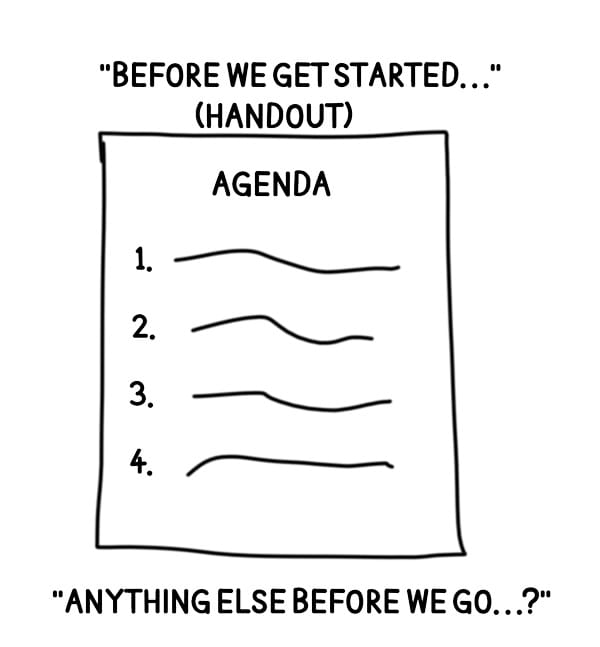
Framing the meeting will dramatically cut down on time spent in meetings and your people will retain more of the content. Framing starts with this phrase, “Today we are going to accomplish this: 1, 2, 3. . .” with all the key points listed in front of everyone. Either on the white board, or on a handout.
Here’s why it works. It forces managers to think about outcomes before the meeting. Plus, humans love lists. Completing the items on a list ties to our desire to show progress. And, we love checking things off lists.
Once you’ve explained what’s going to happen in the meeting, it’s time for the first magic question:
“Before we get started, is there anything we need to discuss. . ?”
This question flushes out the best parts of getting together. The fun side comments, those burning questions, the latest rumors, and new success stories come up. The kinds of stories that would derail most meetings. By framing/listing the important items that need to happen up front, followed by the first magic question, you’re doing two things. First, you're flushing out important issues that need to be discussed. Second, with the pressure of the actual agenda hanging over everyone's head, these important but distracting items are either brief or tabled for later. A simple transition like, “enough on those topics, let’s get through this,” while pointing to the agenda, gets everyone on track.
It works.
But there’s a second magic question I need to tell you about. It's asked right after we complete the list.
“We’re done," you say, "is there anything else before we go?”
This does two more things for you. One, it’s a natural question to signal a wrapping up of the meeting, and two, it provides continuation for the next meeting topics.
I submit that by using this framework and these magic questions, your meetings will be done in less than 20 minutes.
But that's not the best part.
Better meetings lead to better meetings. Your sales team spends too much time relationship building and not enough time digging into your prospects’ businesses. By running meetings with this framework you are teaching your people an effective way to get more from time spent with prospects. “We become that which we see every day,” says the wise man. After experiencing your new effective meetings, your people’s time with clients will be more productive. If you practice it, in a few short months you’ll see your people using it in their presentations.
And that’s how to improve sales meetings.
Random Stuff
"Every man takes the limits of his own field of vision for the limits of the world."
– Arthur Schopenhauer, severe-looking German philosopher

Are you a fan of Tiny Desk Concerts? I love it when a new one drops and this morning's is the ultra-cool French band Air. So suave. So. . .airy.
Listening to "Cherry Blossom Girl" reminded me of how much I like the soundtrack to "The Virgin Suicides." I never saw the movie, but that memory led to thinking about a friend and I walking and talking about our kids. It was late winter, but cold like it is now. At the time we had boys in high school and were telling stories about how the kids were doing navigating their adolescence. At that moment mine were thriving, but one of his was not. My friend was rightfully distraught and I felt for him. I had just watched a documentary on a star athlete who suffered manic depression. At the time this young star was only a few years older than our kids. He took his life in his early twenties. Very sad. Nothing a parent should have to go through.
My takeaway from the documentary, and the message we needed to deliver to our kids, I told my friend, is to get them to understand now is not forever. If the kids can just stay curious about the future, they'll make it through the tough times and come out the other side.
This applies to all of us, of course. And right now I need to keep now is not forever top of mind too. I'm deep into the incredibly boring, smelly process of descaling the expresso machine with vinegar and it's literally taking forever.


