


Quick notes to help you grow your business in less time with less effort. . . starting next week.
In this issue:
- Thoughts on Metrics
- Being Human
- Random Stuff
Thoughts on Metrics
- As buyers, we want outcomes. Evidence that what we're doing is working. Evidence = measurement. Once the measurement is declared and reported publicly, the outcome usually comes true. It's the power of measuring a thing: what gets measured, gets managed. Powerful stuff.
- As we manage our metrics, we see a funny thing happen: our people start gaming the system. Not in a bad way, but in a way to get results. Once a measure is front and center with a target attached to it, our brains come up with ways to make it happen. Sometimes in the way we expect, other times we're surprised by the path taken. The firms we sell to experience this too.
- Knowing what our prospects are measuring is great for business development. "Re-work is costing us a fortune!" sounds like something worth solving, but it's vague. Knowing what we know about metrics, we can nod our heads in agreement, and look for the evidence, asking, ". . .where does that show up in your reports? What is it now? What do you want it to be? What's the value?"
- Once we've identified the metric our prospects are focusing on, we need to take it a step further and ask how they'll know they're making progress. We want outcomes but usually not at the expense of everything. Taking a minute to learn about their "leading indicators" helps everyone stay on track during projects with long timelines.
Being Human – The measure becomes the target
"Anticipatory plagiarism occurs when someone steals your original idea and publishes it a hundred years before you were born." – Robert K. Merton
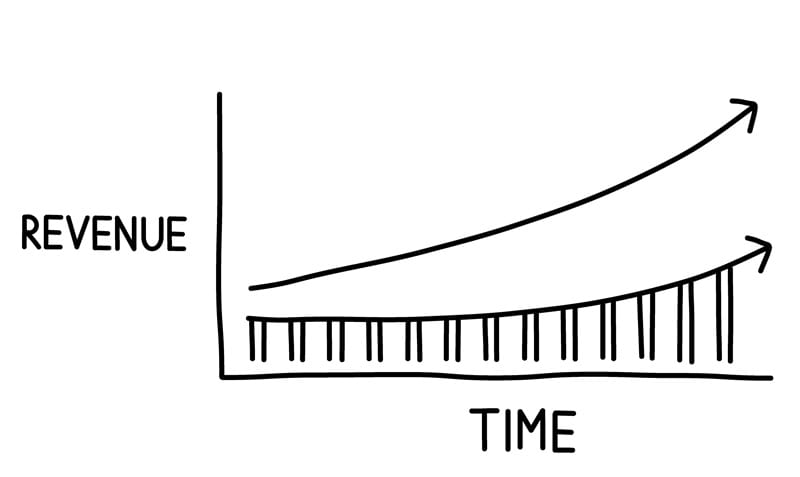
Early in my sales career, I was taught to treat sales as a numbers game. It worked, more or less, and when I became a manager it was expected that I would manage the numbers. It's all about making the number. Which one, you ask? All of them!
And guess what. We did. Whatever number we focused on went "up and to the right" and then we'd focus on another one. And another one. Which was the best one? I never figured it out. Only that we needed to track it with vigor and it would get better, but then kind of fall apart later. My lesson was to change what we measured often. Keep all the balls in the air, so to speak.
I've been thinking about this after reading this book(s) review, For Every Winner, A Loser. The reviewer covers a book about trader Ray Dalio, "The Fund," and a bank currency trader, "The Trading Game." The reviewer uses these books to describe how certain finance activities have grown into the largest business sector in the world.
The review isn’t about making the number per se, but it reminded me about the unintended consequences of focusing on a number.
In 1940, a smart man named Robert Merton called a phenomenon he noticed “goal displacement“. It’s the process by which "instrumental values become terminal values." When the means transform into the ends. His students developed this into a study of how bureaucracies drift from their stated purposes toward the optimization of whatever they are measured on internally. From these studies, we learn that when the measure becomes a target, it’s no longer a good measure. My solution, as I said earlier, is just to find another measure. My shortcut is now under pressure from LLMs. They make hitting most sales measures a cakewalk. Click, click, done. We can now monitor hundreds of metrics at the same time, with ease. Useful metrics half-lives just got shorter making my workaround almost useless. Interesting times.
The takeaway: We need to be careful what we measure because it just might become our people's target number.
And we always make our number.
Random Stuff
“He does confess he feels himself distracted;/But from what cause he will by no means speak.”–Rosencrantz and Guildenstern reporting to the King and Queen

I’m in the middle of a new experiment. I cancelled my live TV streaming service and a couple ancillary channels. I’ve tried this in the past and ended up subscribing to even more services. That might happen again, but for now I’m hanging in there. I’m reading more books, sleeping well, and feeling less distracted.
[Narrator] It’s been three weeks.
It’s my little rebellion against the tech overlords. Each time I pick up my device, each time I pat my pant pocket to make sure I have it, and each phantom vibration I check on is a reminder that my attention isn’t under my control. I dream of being technologically unencumbered, then unironically whip out my device to research how other people have broken free from their devices.
Last night we saw “Hamnet” at our local movie theater. It was great. A period story about Shakespeare imagining part of his life and marriage. Lush scenery, detailed set designs, period costumes, and language all combined to put the audience in the moment.
Except me. I kept thinking things like, “interesting, I should look that up,” and “wow, how did they know that back then?” All the while looking for pockets in the costumes to hide a phone.
By the end of the show, I conclude that I’d enjoy living in that unconnected time. Who knows, without all these modern distractions keeping me from doing interesting work, I might have even thrived and done something great.
[Narrator] Shakespearean Greg would not have thrived. By age 10 he’d be toiling in a field, eking out a meager existence, and having never learning to read, he would die of the plague before age 20.


